
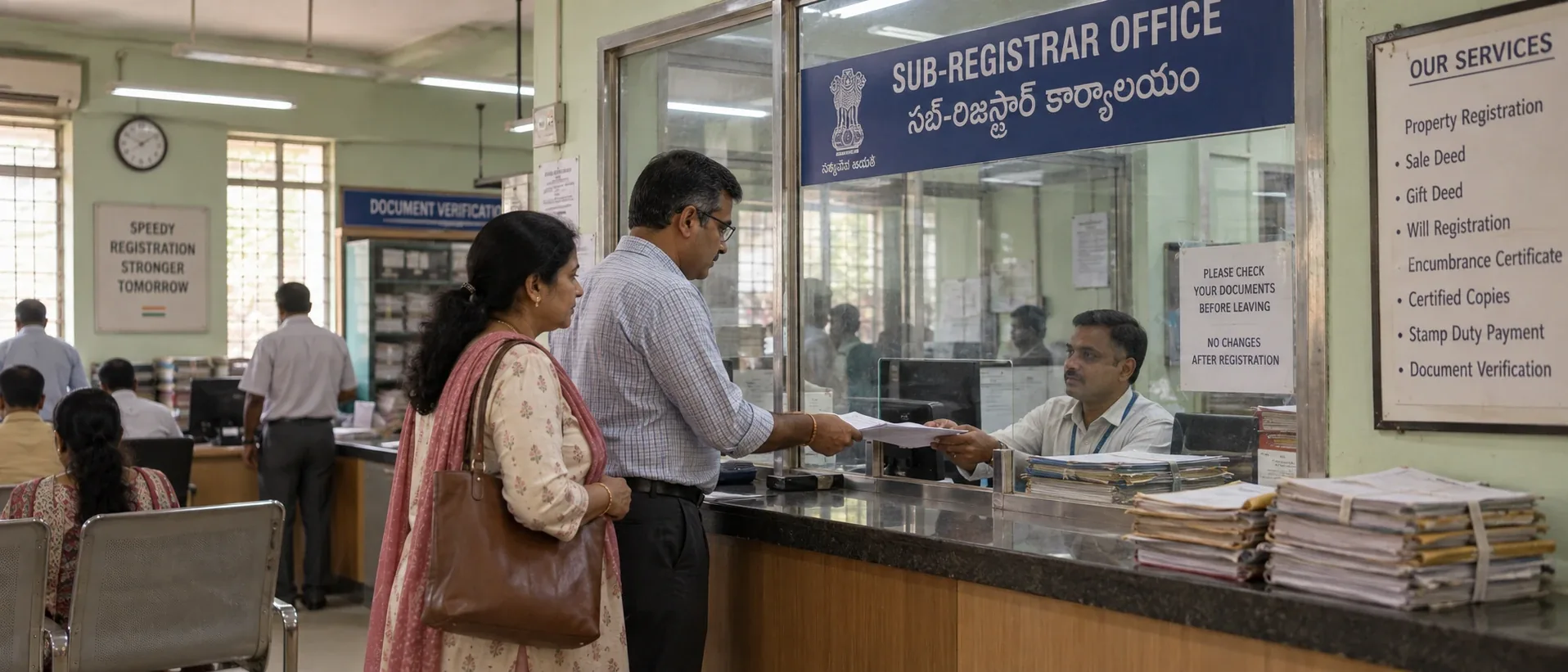
It is the single most common question we are asked, and there is a great deal of confusion about it — including from people who have already made a Will. So let us settle it plainly.
Registering a Will is not compulsory in India. Under Section 18 of the Registration Act, 1908, a Will is listed among documents whose registration is optional. Your Will is legally valid the moment it is properly signed and witnessed, whether or not it ever goes near a Sub-Registrar's office.
That said, "not compulsory" is not the same as "not worth doing." Below is what registration actually achieves, what it does not, and how to decide. For the full process, documents and charges, see our complete guide to Will registration in India.
On this page
What actually makes a Will valid
Under the Indian Succession Act, 1925, a Will is validly executed when three things are true:
- The testator signs it. You must sign or affix your mark to the document, with the intention of giving effect to it as your Will.
- Two witnesses attest it. Both must either watch you sign, or watch you acknowledge your signature, and each must then sign in your presence.
- You are of sound mind and acting freely. You must understand what you own and who you are providing for, and you must not be acting under coercion or undue influence.
That is the whole legal test. Notice what is absent from it: registration, stamp paper, a lawyer's letterhead, and notarisation. None of these are conditions of validity.
Two common myths worth killing
- "A Will must be on stamp paper." It must not. A Will is exempt from stamp duty in India because it only takes effect on death. Plain paper is perfectly valid.
- "An unregistered Will is weak." It is not weak in law. Courts admit unregistered Wills routinely. What matters far more is whether it was signed and witnessed correctly.
What registration does — and doesn't do
When you register a Will, you present it at the Sub-Registrar's office. The Sub-Registrar verifies your identity, records the document in the official register, and retains a copy.
What that gives you:
- An official record of existence. Nobody can credibly claim the Will never existed, because the government holds a copy.
- Protection against loss or destruction. If the original is lost, misplaced, or destroyed by someone who dislikes its contents, a certified copy can be obtained from the registry.
- A harder evidentiary target. A challenger arguing that the signature is forged must explain why a public official verified the testator's identity at the time of registration.
- Confidentiality until death. A registered Will is kept in sealed custody and is not a public document during your lifetime.
What registration does not do:
- It does not make a badly drafted Will valid. If your witnessing was defective, registration will not repair it.
- It does not prevent a challenge. A registered Will can still be contested on sound mind, coercion, or the existence of a later Will.
- It does not freeze your wishes. You can revoke or replace a registered Will at any time by making a new one.
- It does not remove the need for probate where probate is otherwise required.
How Will registration works in practice
The process is more straightforward than most people expect:
- The Will is drafted and signed in the presence of two witnesses, as normal.
- You visit the Sub-Registrar's office with jurisdiction over your area, taking the original Will.
- You attend in person with both witnesses. All three of you must be present; a Will cannot be registered by proxy.
- Identity is verified using Aadhaar, PAN, or passport for you and both witnesses.
- The Sub-Registrar records the document, and the Will is entered in the register and kept in safe custody.
The appointment itself usually takes under an hour. The harder part is coordinating three people's diaries and securing a slot — which is the part we handle for clients on our registration package.
What it costs
The Sub-Registrar's own registration fee for a Will is modest — a few hundred rupees in most states. There is no stamp duty, because a Will is exempt.
What people usually pay for is not the government fee but the drafting and coordination around it. Our Will with Registration package is ₹19,999 as a one-time fee, covering expert drafting, review, a 60-minute consultation, and coordination of the registration appointment in your city. It is available across India excluding Tamil Nadu.
When registration is worth it
Registration is not automatically the right answer. Here is how we advise clients:
| Your situation | Our usual advice |
|---|---|
| Single child, modest estate, no family friction expected | Notarisation is usually sufficient |
| Two or more children, or property involved | Register — disputes between siblings are the most common cause of litigation |
| Second marriage, or a blended family | Register, and consider independent legal advice |
| You are deliberately leaving out a natural heir | Register — expect the Will to be challenged and build the evidentiary record now |
| Significant immovable property | Register |
| You live abroad with assets in India | Register, with attestation in your country of residence |
The underlying principle: the greater the chance somebody will be unhappy with your Will, the more valuable an official record becomes.
The mistake that actually invalidates Wills
In our experience, far more Wills fail because of witnessing errors than because they were unregistered. The most damaging one is this: asking a beneficiary to act as a witness.
Under Section 67 of the Indian Succession Act, 1925, a bequest to a person who attested the Will — or to that person's spouse — can be declared void. The rest of the Will survives, but that particular gift fails. People routinely ask their son or daughter-in-law to sign as a witness, and unknowingly cancel the very gift they intended.
Choose two independent adults who inherit nothing: a neighbour, a colleague, a family doctor.
Frequently asked questions
Is it compulsory to register a Will in India?
No. Registration is optional under Section 18 of the Registration Act, 1908. A Will is valid once signed and attested by two witnesses.
Does an unregistered Will hold up in court?
Yes. Unregistered Wills are admitted to probate regularly. Registration is evidence of authenticity, not a condition of validity.
Can I register a Will after the testator has died?
No. Registration requires the testator to appear in person before the Sub-Registrar. Once they have died, that is no longer possible — which is precisely why registration, if you want it, must be done during your lifetime.
Can a registered Will be changed later?
Yes. You can revoke it and make a new Will at any time while you are of sound mind. The new Will should expressly state that it revokes all previous Wills. If the earlier Will was registered, register the new one too so the record is consistent.
Where should the Will be registered?
At the Sub-Registrar's office having jurisdiction over your place of residence. It does not have to be where your property is located.
Put your Will in place this week
Expert-drafted, with free notarisation or registration in your city. Nothing to pay until your draft is ready.
Start My Will — It's Free to Begin